托福分数测试HOT
托福课程优惠HOT
托福正价课试听0元
新托福机考练习NEW
0元讲座HOT
新版托福入门课程HOT
托福入门导学NEW
4000人报
托福机经
PDF版
TPO练习
官方授权
资料下载
826套
专业测评
40118人已测
高分经验
1193帖

扫码免费领资料
托福全科备考资料
免费水平测试及规划

扫码关注掌握一手留学资讯
回复XDF免费水平测试
为了帮助大家高效备考托福,熟悉托福听力加试和托福阅读加试,新东方在线托福网为大家带来托福听力经典加试成过去时 托福阅读加试成重点一文,希望对大家托福备考有所帮助。更多精彩尽请关注新东方在线托福网(http://toefl.koolearn.com)!
最近一两个月的托福考试中,频现阅读单加试,听力不加试的情况。慢慢的,听力经典加试将会淡出托福考试,广大考生迎来了阅读单加试的时代。下面我们来看一段让考生颇为头疼的阅读经典加试回忆:
讨论地核物质成分,科学家根据地震波传导的快慢,确定了地核的成分与地表的成分不同。然后科学家发现火山爆发出来的物质有钻石,证明地球深层是一个高温高压的环境,因为钻石只能在这种情况下产生。 然后来了一段很长的,哎,如果他分开写成几段就好了。说根据陨石里面的材料来判定地核的材料。因为科学家可以估计地核的密度,如果发现陨石的密度与地核密度差不多,很有可能他们的element(元素成份)是相同的。有一道题目问地核的构成物质最多是什么,有iron, silicon(硅),还有两个忘记了......
根据此加试回忆,我们找到了高度相似的阅读原文供大家练习和参考:
The structure of the Earth

Imagine a Scotch egg......
1.The outer shell of the Earth is called the CRUST (breadcrumbs)
2.The next layer is called the MANTLE (sausagemeat)
3.The next layer is the liquid OUTER CORE (egg white)
4.The middle bit is called the solid INNER CORE (egg yolk)
The deepest anyone has drilled into the earth is around 12 kilometres, we've only scratched the surface. How do we know what's going on deep underground?
There are lots of clues:
There are lots of clues:
●The overall density of the Earth is much higher than the density of the rocks we find in the crust. This tells us that the inside must be made of something much denser than rock.
●Meteorites (created at the same time as the Earth, 4.6 billion years ago) have been analyzed. The commonest type is called a chondrite and they contain iron, silicon, magnesium and oxygen (Others contain iron and nickel). A meteorite has roughly the same density as the whole earth. A meteorite minus its iron has a density roughly the same as Mantle rock (e.g. the mineral called olivine).
●Iron and Nickel are both dense and magnetic.
●Scientists can follow the path of seismic waves from earthquakes as they travel through the Earth. The inner core of the Earth appears to be solid whilst the outer core is liquid (s waves do not travel through liquids). The mantle is mainly solid as it is under extreme pressure (see below). We know that the mantle rocks are under extreme pressure, diamond is made from carbon deposits and is created in rocks that come from depths of 150-300 kilometres that have been squeezed under massive pressures.
●The Earth is sphere with a diameter of about 12,700Kilometres. As we go deeper and deeper into the earth the temperature and pressure rises. The core temperature is believed to be an incredible 5000-6000°c.
●The crust is very thin (average 20Km). This does not sound very thin but if you were to imagine the Earth as a football, the crust would be about ½millimetre thick. The thinnest parts are under the oceans (OCEANIC CRUST) and go to a depth of roughly 10 kilometres. The thickest parts are the continents (CONTINENTAL CRUST) which extend down to 35 kilometres on average. The continental crust in the Himalayas is some 75 kilometres deep.
●The mantle is the layer beneath the crust which extends about half way to the centre. It's made of solid rock and behaves like an extremely viscous liquid - (This is the tricky bit... the mantle is a solid which flows) The convection of heat from the centre of the Earth is what ultimately drives the movement of the tectonic plates and cause mountains to rise.
●The outer core is the layer beneath the mantle. It is made of liquid iron and nickel. Complex convection currents give rise to a dynamo effect which is responsible for the Earth's magnetic field.
●The inner core is the bit in the middle!. It is made of solid iron and nickel. Temperatures in the core are thought to be in the region of 5000-6000°c and it's solid due to the massive pressure.
HERE IS SOME EXTRA STUFF (IN A LOT MORE DETAIL THAN WE NEED FOR GCSE):
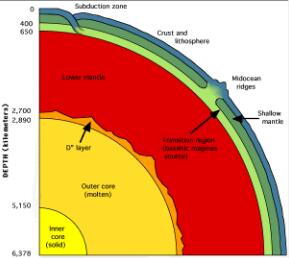
This diagram shows a detailed picture of the Earth's interior. Crust is being created at the mid ocean ridges and being eaten at the subduction zones. The movement processes are driven by the convection currents created by the heat produced by natural radioactive processes deep within the Earth.
Inner core:depth of 5,150-6,370 kilometres
The inner core is made of solid iron and nickel and is unattached to the mantle, suspended in the molten outer core. It is believed to have solidified as a result of pressure-freezing which occurs to most liquids under extreme pressure.
Outer core: depth of 2,890-5,150 kilometres
The outer core is a hot, electrically conducting liquid (mainly Iron and Nickel). This conductive layer combines with Earth's rotation to create a dynamo effect that maintains a system of electrical currents creating the Earth's magnetic field. It is also responsible for the subtle jerking of Earth's rotation. This layer is not as dense as pure molten iron, which indicates the presence of lighter elements. Scientists suspect that about 10% of the layer is composed of sulphur and oxygen because these elements are abundant in the cosmos and dissolve readily in molten iron.
D" layer: depth of 2,700-2,890 kilometres
This layer is 200 to 300 kilometres thick. Although it is often identified as part of the lower mantle, seismic evidence suggests the D" layer might differ chemically from the lower mantle lying above it. Scientists think that the material either dissolved in the core, or was able to sink through the mantle but not into the core because of its density.
Lower mantle: depth of 650-2,890 kilometres
The lower mantle is probably composed mainly of silicon, magnesium, and oxygen. It probably also contains some iron, calcium, and aluminium. Scientists make these deductions by assuming the Earth has a similar abundance and proportion of cosmic elements as found in the Sun and primitive meteorites.
Transition region: depth of 400-650 kilometres
The transition region or mesosphere (for middle mantle), sometimes called the fertile layer and is the source of basaltic magmas. It also contains calcium, aluminium, and garnet, which is a complex aluminium-bearing silicate mineral. This layer is dense when cold because of the garnet. It is buoyant when hot because these minerals melt easily to form basalt which can then rise through the upper layers as magma.
Upper mantle: depth of 10-400 kilometres
Solid fragments of the upper mantle have been found in eroded mountain belts and volcanic eruptions. Olivine (Mg,Fe)2SiO4 and pyroxene (Mg,Fe)SiO3 have been found. These and other minerals are crystalline at high temperatures. Part of the upper mantle called the asthenosphere might be partially molten.
Oceanic crust: depth of 0-10 kilometres
The majority of the Earth's crust was made through volcanic activity. The oceanic ridge system, a 40,000 kilometre network of volcanoes, generates new oceanic crust at the rate of 17 km3 per year, covering the ocean floor with an igneous rock called basalt. Hawaii and Iceland are two examples of the accumulation of basalt islands.
Continental crust: depth of 0-75 kilometres
This is the outer part of the Earth composed essentially of crystalline rocks. These are low-density buoyant minerals dominated mostly by quartz (SiO2) and feldspars (metal-poor silicates). The crust is the surface of the Earth. Because cold rocks deform slowly, we refer to this rigid outer shell as the lithosphere (the rocky or strong layer).
以上就是新东方在线托福网为你带来的托福听力经典加试成过去时 托福阅读加试成重点,更多精彩敬请关注新东方在线托福网(http://toefl.koolearn.com)。
 资料下载
资料下载
2021-2025托福机经试题|答案|范文下载
发布时间:2024-02-21关注新东方在线托福
回复【XDF】获取
托福全科备考资料大礼包
发布时间:2024-02-21关注新东方在线托福
回复【XDF】获取
托福正价课试听课程包
发布时间:2024-02-21关注新东方在线托福
回复【XDF】获取
托福定制备考规划
发布时间:2024-02-21关注新东方在线托福
回复【XDF】获取
托福TPO免费模考
发布时间:2024-02-21关注新东方在线托福
回复【XDF】获取
托福免费水平测试
发布时间:2024-02-21关注新东方在线托福
回复【XDF】获取
托福写作新题型模拟题+范文汇总[ETS发布]
发布时间:2023-07-30关注新东方在线托福
回复【XDF】获取
2023全年托福机经PDF版下载
发布时间:2023-06-17关注新东方在线托福
回复【XDF】获取
2022全年托福机经PDF版下载
发布时间:2023-06-17关注新东方在线托福
回复【XDF】获取
2022全年写作托福机经整理
发布时间:2023-01-13关注新东方在线托福
回复【XDF】获取
2022年托福考后题目回忆
发布时间:2023-01-13关注新东方在线托福
回复【XDF】获取
托福口语黄金80题附录音
发布时间:2023-01-13关注新东方在线托福
回复【XDF】获取
新东方IBT写作网络课堂录音[.rar]
发布时间:2023-01-13关注新东方在线托福
回复【XDF】获取
21天托福听力提升计划
发布时间:2023-01-13关注新东方在线托福
回复【XDF】获取
不怕跑题偏题,这份写作资料请收好
发布时间:2023-01-13关注新东方在线托福
回复【XDF】获取
托福阅读提分技巧锦囊妙计
发布时间:2023-01-13关注新东方在线托福
回复【XDF】获取
口语拖后腿?因为你缺少这套万能句式资料
发布时间:2019-11-01关注新东方在线托福
回复【XDF】获取
攻破托福听力难关的资料包
发布时间:2023-01-13关注新东方在线托福
回复【XDF】获取
看剧学英语,经典美剧一键获取
发布时间:2019-11-01关注新东方在线托福
回复【XDF】获取
原版外刊资源合集|精心打包整理
发布时间:2019-11-01关注新东方在线托福
回复【XDF】获取

关注新东方在线托福,
回复【XDF】获取大礼包

 推荐阅读
推荐阅读
托福考试网整理了2024托福考试时间、托福考试内容、托福写作新题型样题+范文、托福考题等内容,今天带来的是ETS官方托福阅读模拟题【2】,希望对同学们托福考试有所帮助!
托福考试网整理了2024托福考试时间、托福考试内容、托福写作新题型样题+范文、托福考题等内容,今天带来的是ETS官方托福阅读模拟题【1】,希望对同学们托福考试有所帮助!
托福考试网为大家整理了2024年托福阅读评分标准、托福阅读考试时间、托福阅读备考攻略等内容,今天给大家带来的是2024年1月托福考试考前刷题:阅读题(4),供大家参考!
托福考试网为大家整理了2024年托福阅读评分标准、托福阅读考试时间、托福阅读备考攻略等内容,今天给大家带来的是2024年1月托福考试考前刷题:阅读题(3),供大家参考!
托福考试网为大家整理了2024年托福阅读评分标准、托福阅读考试时间、托福阅读备考攻略等内容,今天给大家带来的是2024年1月托福考试考前刷题:阅读题(2),供大家参考!

资料下载
关注新东方在线托福
回复【XDF】获取
关注新东方在线托福
回复【XDF】获取
关注新东方在线托福
回复【XDF】获取
关注新东方在线托福
回复【XDF】获取
关注新东方在线托福
回复【XDF】获取
关注新东方在线托福
回复【XDF】获取
关注新东方在线托福
回复【XDF】获取
关注新东方在线托福
回复【XDF】获取
关注新东方在线托福
回复【XDF】获取
关注新东方在线托福
回复【XDF】获取
关注新东方在线托福
回复【XDF】获取
关注新东方在线托福
回复【XDF】获取
关注新东方在线托福
回复【XDF】获取
关注新东方在线托福
回复【XDF】获取
关注新东方在线托福
回复【XDF】获取
关注新东方在线托福
回复【XDF】获取
关注新东方在线托福
回复【XDF】获取
关注新东方在线托福
回复【XDF】获取
关注新东方在线托福
回复【XDF】获取
关注新东方在线托福
回复【XDF】获取
 阅读排行榜
阅读排行榜
 相关内容
相关内容

 托福公益讲座
 托福考试练习相关
 网友热搜
网友热搜