2014-08-01 17:10:17 来源:新东方在线论坛托福资料下载
Conversation 2
1. What is the conversation mainly about?
A. Methods for finding appropriate sources for a project.
B. Reasons the woman is having difficulties with a project.
C. Criteria the professor uses to evaluate group projects.
D. Ways to develop the skills needed to work in groups.
2. Why does the professor mention the 'free-rider' problem?
A. To review a concept he explained in class.
B. To give the student a plan to solve her problem.
C. To clarify the problem the student is facing.
D. To explain a benefit of working in groups.
3. What is the professor's opinion of the other students in the woman's group?
A. They try to take credit for work they did not do.
B. They did not perform well in previous courses with him.
C. They are more motivated when they are working in a group.
D. They do good work when they are interested in the subject
4. Why did the woman choose property rights as a topic?
A. The professor recommended the topic.
B. She already had a lot of reference materials on the subject.
C. She wanted to learn something new.
D. It was easy to research at the school library.
5. What mistakes does the professor imply the woman has made while working on a project?
Click on 2 answers
A. Finding sources for her group partners.
B. Writing the weekly progress reports for her group.
C. Forgetting to pay attention to the project's deadlines.
D. Failing to involve the group members in the selection of a topic.
Lecture 3
6. What does the professor mainly discuss?
A. His plans for research involving moving rocks.
B. A difference between two geological forces that cause rocks to move.
C. Theories about why desert rocks move.
D. Reasons why geologists should study moving rocks.
7. According to the professor, what have the researchers agreed on?
A. The rocks cannot move after ice storms.
B. The rocks do not move at night.
C. The rocks never move in circles.
D. The rocks are not moved by people.
8. The professor mentions experiments on the wind speed necessary to move rocks. What is the professor's attitude toward the experiments?
A. Their results were decisive.
B. They were not carried out carefully.
C. They were not continued long enough to reach a conclusion.
D. The government should not have allowed the experiments.
9. What important point does the professor make about the area where the rocks are found?
A. It has been the site of Earth's highest wind speeds.
B. It is subject to laws that restrict experimentation.
C. It is accessible to heavy machinery.
D. It is not subject to significant changes in temperature.
10. What is the professor's purpose in telling the students about moving rocks?
A. To teach a lesson about the structure of solid matter.
B. To share a recent advance in geology.
C. To give an example of how ice can move rocks.
D. To show how geologists need to combine information from several fields.
11. Replay: What does the professor imply when he says this:
A. The movement pattern of the rocks was misreported by researchers.
B. The rocks are probably being moved by people.
C. The movement pattern of the rocks does not support the wind theory.
D. There must be differences in the rocks' composition.
Lecture 4
12. What is the lecture mainly about?
A. Reasons the United States government should not support the arts.
B. The history of government support for the arts in the United States.
C. Strengths and weaknesses of different government-sponsored arts programs.
D. Different ways in which governments can help support artists.
13. According to the talk, in what two ways was the Federal Art Project successful?
Click on 2 answers.
A. It established standards for art schools.
B. It provided jobs for many artists.
C. It produced many excellent artists.
D. It gave many people greater access to the arts.
14. The class discusses some important events related to government support for the arts in the United States. Put the events in order from earliest to latest.
Answer Choices.
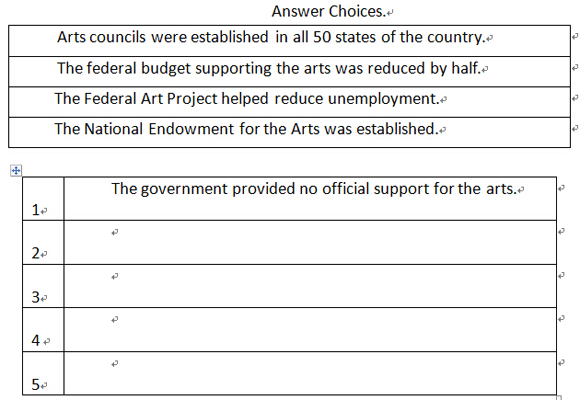
15. Why does the professor mention the Kennedy Center and Lincoln Center?
A. To give example s of institutions that benefit from corporate support.
B. To illustrate why some artists oppose the building of cultural centers.
C. To show how two centers were named after presidents who supported the arts.
D. To name two art centers built by the government during the Depression.
16. What does the professor say about artists' opinions of government support for the arts?
A. Most artists believe that the government should provide more funding for the art
B. Most artists approve of the ways in which the government supports the arts.
C. Even artists do not agree on whether the government should support the arts.
D. Even artists have a low opinion of government support for the arts.
17. Replay: What does the professor imply when she says this:
A. Others students should comment on the man's remark.
B. Most people would agree with the man's opinion.
C. Artwork funded by the government is usually of excellent quality.
D. The government project was not a waste of money.
本文关键字: TPO4听力题目 tpo听力题目 tpo听力答案

 资料下载
资料下载
2021-2025托福机经试题|答案|范文下载
发布时间:2024-02-21关注新东方在线托福
回复【XDF】获取
托福全科备考资料大礼包
发布时间:2024-02-21关注新东方在线托福
回复【XDF】获取
托福正价课试听课程包
发布时间:2024-02-21关注新东方在线托福
回复【XDF】获取
托福定制备考规划
发布时间:2024-02-21关注新东方在线托福
回复【XDF】获取
托福TPO免费模考
发布时间:2024-02-21关注新东方在线托福
回复【XDF】获取
托福免费水平测试
发布时间:2024-02-21关注新东方在线托福
回复【XDF】获取
托福写作新题型模拟题+范文汇总[ETS发布]
发布时间:2023-07-30关注新东方在线托福
回复【XDF】获取
2023全年托福机经PDF版下载
发布时间:2023-06-17关注新东方在线托福
回复【XDF】获取
2022全年托福机经PDF版下载
发布时间:2023-06-17关注新东方在线托福
回复【XDF】获取
2022全年写作托福机经整理
发布时间:2023-01-13关注新东方在线托福
回复【XDF】获取
2022年托福考后题目回忆
发布时间:2023-01-13关注新东方在线托福
回复【XDF】获取
托福口语黄金80题附录音
发布时间:2023-01-13关注新东方在线托福
回复【XDF】获取
新东方IBT写作网络课堂录音[.rar]
发布时间:2023-01-13关注新东方在线托福
回复【XDF】获取
21天托福听力提升计划
发布时间:2023-01-13关注新东方在线托福
回复【XDF】获取
不怕跑题偏题,这份写作资料请收好
发布时间:2023-01-13关注新东方在线托福
回复【XDF】获取
托福阅读提分技巧锦囊妙计
发布时间:2023-01-13关注新东方在线托福
回复【XDF】获取
口语拖后腿?因为你缺少这套万能句式资料
发布时间:2019-11-01关注新东方在线托福
回复【XDF】获取
攻破托福听力难关的资料包
发布时间:2023-01-13关注新东方在线托福
回复【XDF】获取
看剧学英语,经典美剧一键获取
发布时间:2019-11-01关注新东方在线托福
回复【XDF】获取
原版外刊资源合集|精心打包整理
发布时间:2019-11-01关注新东方在线托福
回复【XDF】获取

关注新东方在线托福,
回复【XDF】获取大礼包

版权及免责声明
1,"新东方在线"上的内容,包括文章、资料、资讯等, 本网注明"稿件来源:新东方在线"的,其版权 均为"新东方在线"或北京新东方迅程网络科技有限公司所有 ,任何公司、媒体、网站或个人未经授权不得转载、链接、转贴或以其他方式使用。已经得到 "新东方在线"许可 的媒体、网站,在使用时必须注明"稿件来源:新东方",违者本网站将依法追究责任。
2, "新东方在线" 未注明"稿件来源:新东方"的 文章、资料、资讯等 均为转载稿,本网站转载出于传递更多信息之目的,并不意味着赞同其观点或证实其内容的真实性。如其他媒体、网站或个人从本网站下载使用,必须保留本网站注明的"稿件来源",并自负版权等法律责任。如擅自篡改为 " 稿件来源:新东方 " ,本网站将依法追究其法律责任。
3,如本网转载稿涉及版权等问题,请作者见稿后在两周内与新东方在线联系。

资料下载
关注新东方在线托福
回复【XDF】获取
关注新东方在线托福
回复【XDF】获取
关注新东方在线托福
回复【XDF】获取
关注新东方在线托福
回复【XDF】获取
关注新东方在线托福
回复【XDF】获取
关注新东方在线托福
回复【XDF】获取
关注新东方在线托福
回复【XDF】获取
关注新东方在线托福
回复【XDF】获取
关注新东方在线托福
回复【XDF】获取
关注新东方在线托福
回复【XDF】获取
关注新东方在线托福
回复【XDF】获取
关注新东方在线托福
回复【XDF】获取
关注新东方在线托福
回复【XDF】获取
关注新东方在线托福
回复【XDF】获取
关注新东方在线托福
回复【XDF】获取
关注新东方在线托福
回复【XDF】获取
关注新东方在线托福
回复【XDF】获取
关注新东方在线托福
回复【XDF】获取
关注新东方在线托福
回复【XDF】获取
关注新东方在线托福
回复【XDF】获取
关于我们 - 商务合作 - 广告服务 - 代理商区域 - 客服中心 - 在线留言 - 退换货说明 - 合作伙伴 - 联系我们 - 人员招聘 - 网站地图 - 热点关注 - 寓乐优学
新东方教育科技集团旗下成员公司 全国客服专线:400-676-3300
Copyright © 2000-2016 koolearn.com Inc. All rights reserved. 新东方在线 版权所有
京ICP证050421号 京ICP备05067669号 京公网安备11010802017616号 网络视听许可证0110531号






 网友热搜
网友热搜 托福公益讲座
 托福考试练习相关